
Clinically Reviewed by:

Brain mapping for depression helps show how your brain is functioning in real time.
When depression is not improving, it can be hard to understand why. You may feel unmotivated, mentally foggy, or like nothing is working the way it should.
Looking at brain activity can help explain what is happening beneath the surface and why those symptoms are sticking around.
Here’s what brain mapping can help reveal about depression:
Depression is often described as a mental health condition, but for many people it feels just as physical as it does emotional.
You might notice:
This is not a lack of effort. It is often tied to how certain areas of the brain are functioning.
When regions that control mood, focus, and energy are underactive or out of sync, everyday things can start to feel harder than they should. Even things you want to do can feel out of reach.
This is part of why depression can be so frustrating. You may want to feel better, but your brain is not responding the way it used to.
Brain mapping looks at how different areas of your brain are functioning and how they work together.
When you’re dealing with depression, certain parts of the brain can become underactive or out of sync. One of the most important is the prefrontal cortex, which plays a key role in motivation, focus, and emotional control.
When this area isn’t as active as it should be, it can feel like:
Brain mapping uses EEG technology to measure this activity and show where things may be off.
Instead of relying only on symptoms, it gives a clearer picture of how your brain is functioning, which can help explain why those symptoms are sticking around. ⓘ
If you want a broader overview of how this type of testing is used across different conditions, you can learn more about brain mapping for mental health treatment.
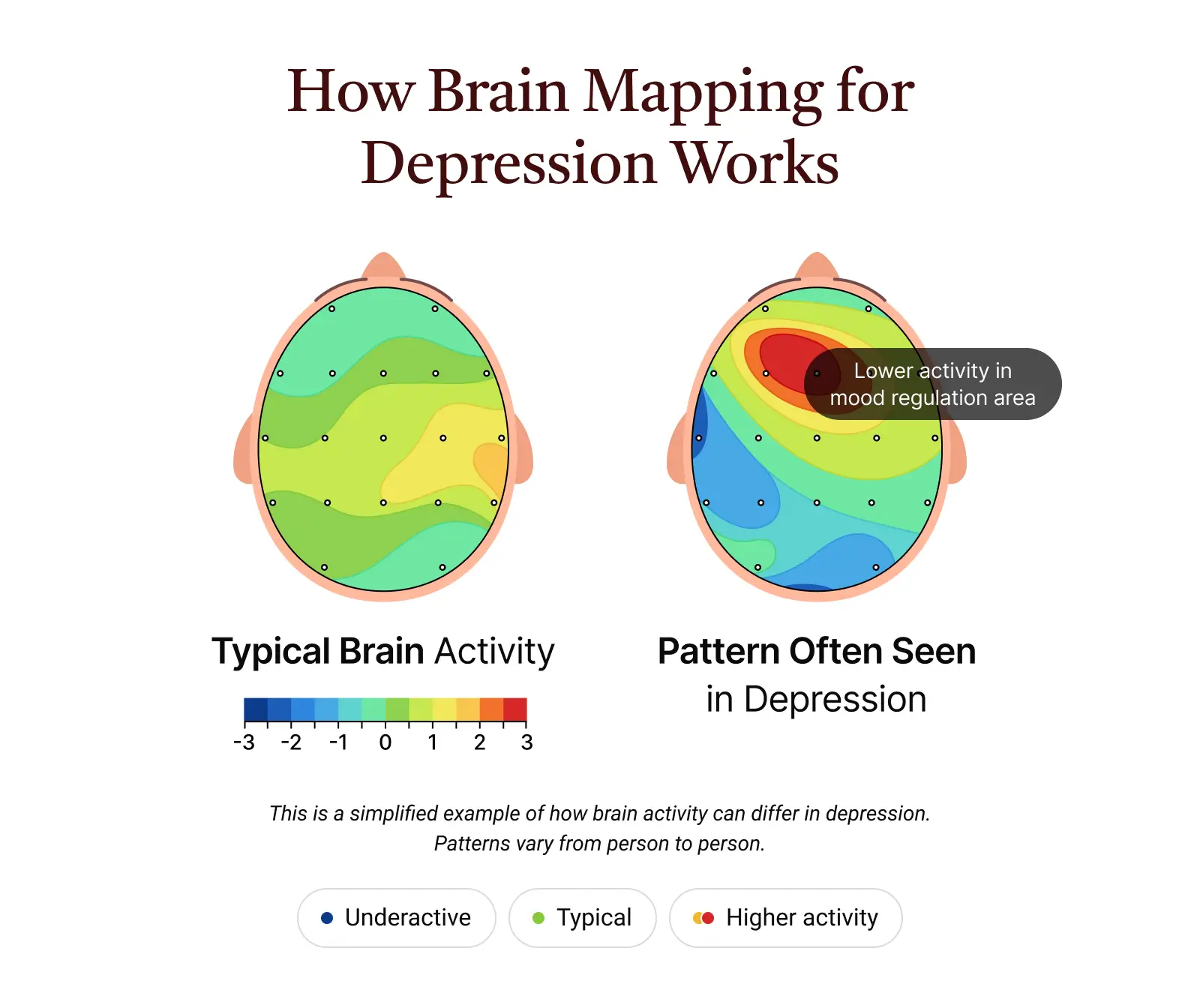
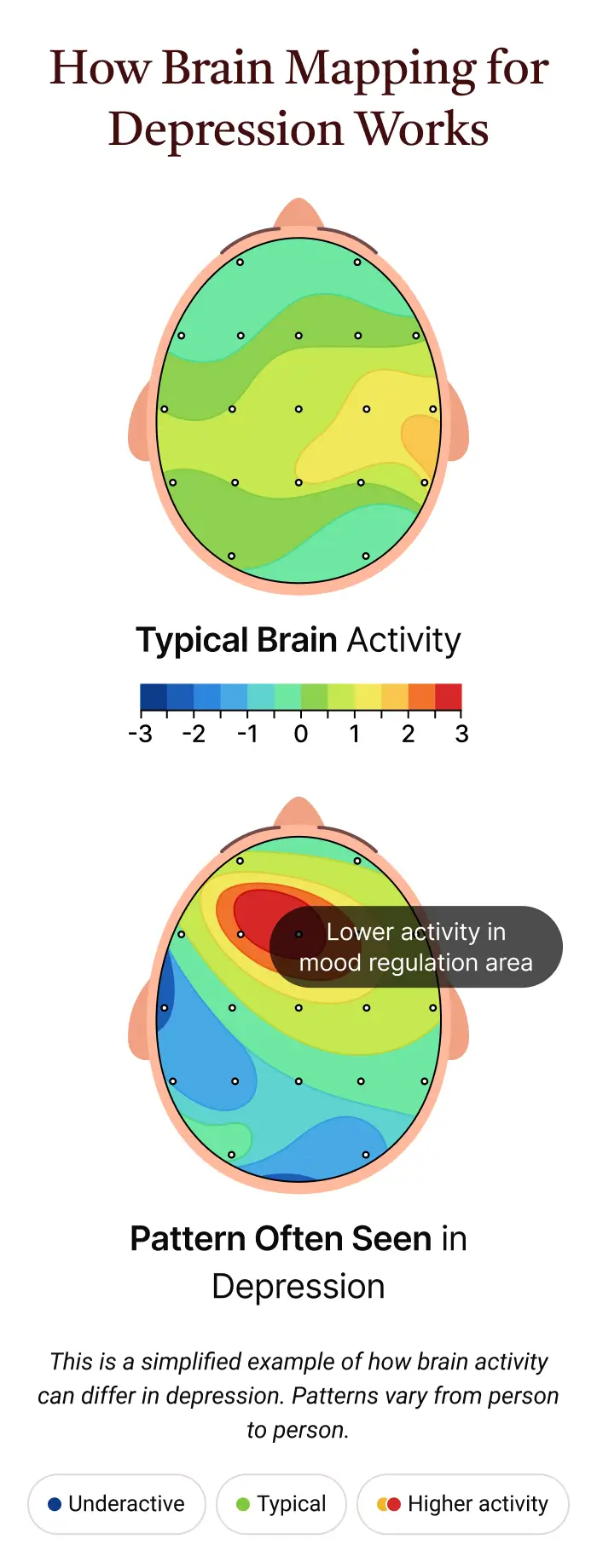
A brain map shows how active different areas of your brain are and how those areas are working together. The results are displayed as a color-coded image, which makes patterns easier to see.
In depression, certain patterns tend to show up more often:
These patterns can give a clearer picture of how depression may be affecting your brain. Instead of relying only on symptoms, it helps show where support may be needed. ⓘ
If you want to better understand how to read these patterns and what they mean, you can explore a deeper breakdown of brain mapping results and how they relate to mental health symptoms.
Yes. Brain mapping is backed by decades of research showing that depression is linked to measurable changes in how the brain functions.
Depression is not just emotional. It is connected to real, observable patterns in brain activity, especially in areas that control mood, motivation, and emotional regulation.
One of the most well-known findings is the difference in activity between the left and right sides of the prefrontal cortex. Researchers, including Dr. Richard Davidson at the University of Wisconsin–Madison, have helped establish these connections.
Brain mapping does not treat depression on its own. It is used to better understand these patterns so care can be more focused, especially when symptoms have not improved with standard approaches.
Brain mapping does not tell you exactly what to do next, but it can make the next step clearer.
When patterns show up in how your brain is functioning, it can help guide decisions around treatment, especially if depression has not improved the way you expected.
For some people, this may point toward:
The goal is not to add more treatment. It is to make sure the next step is actually aligned with what is going on in your brain.
Brain mapping is not the first step for everyone dealing with depression.
But it can be helpful when things are not improving the way you expected or when your symptoms do not follow a clear pattern.
You might relate to this if:
At that point, it is not about doing more. It is about understanding what is actually going on.
Brain mapping may be especially helpful in situations like:
Brain mapping is not required for diagnosis or treatment. But when depression is not improving, it can help create a clearer direction for what to try next.
If anxiety is also part of what you’re experiencing, it can help to understand how brain mapping for anxiety works and what it can show.
Brain mapping can show patterns in how your brain is functioning, but it is not a standalone diagnosis.
It does not:
What it can do is give a clearer picture of how different areas of your brain are working together.
For people who feel stuck or unsure what to try next, that added clarity can make a meaningful difference. It helps take some of the guesswork out of the process and makes the next step more focused.
When depression has not improved with therapy or medication, the problem is not always a lack of effort. Sometimes the brain needs a closer look.
Brain mapping can help identify patterns that may be keeping symptoms in place so treatment can be guided more precisely. As part of a broader mental health treatment approach, it can help clarify what to do next and whether options like TMS therapy for depression may be a better fit.
If you are tired of guessing and want clearer answers, call (844) 650-0064 to talk through what evaluation and treatment could look like.
You’re reading this for a reason. Even if you don’t know if you’re “ready”, now is the best time to reach out.
 100% Confidential
No judgement
No commitment
 Call (844) 650-0064
  Available Now
  Verify Your Insurance

Error: Contact form not found.
 Get Answers Now
You don’t have to figure this out alone. We can guide you through your options—completely confidential and with zero commitment.
100% Private