
 100% Confidential

How to Become a Recovery Peer Coach After Treatment in Indiana
Clinically Reviewed by:

There may come a point after treatment when you start thinking, I want to help someone else get through this too.
Maybe someone helped you when you were scared, unsure, newly sober, or trying to figure out what life was supposed to look like after treatment. Maybe a staff member, sponsor, alumni program contact, friend, or person further along in recovery said something that stayed with you. Maybe they helped you believe things could change before you fully believed it yourself.
Recovery peer coaching is one way to become that kind of support for someone else.
This guide walks through what recovery peer coaching is, what peer coaches actually do, what training and certification can look like in Indiana, and how to know whether this is the right next step for you.
Key Takeaways and Helpful Links
If you are interested in becoming a recovery peer coach in Indiana, these are the main places to start:
- Indiana Certified Peer Support Professional, or CPSP: A state-recognized peer support certification through Indiana DMHA.
- Certified Peer Recovery Coach-Associate, or CPRC-A: An introductory peer recovery coach credential through ICAADA.
- Certified Peer Recovery Coach, or CPRC: A more advanced ICAADA credential for people with more peer recovery support experience.
- Indiana Center for Recovery Alumni Program: A good starting place if you want to stay connected, encourage others, and explore whether peer support feels like the right next step.
- SAMHSA Peer Support Resources: Helpful background on what peer support workers do and how peer support works.
What Is Recovery Peer Coaching?
Recovery peer coaching is support from someone who has been through recovery themselves and is trained to help others move forward in their own recovery.
A peer coach is there to support someone going through treatment or early recovery by connecting through real lived experience. They understand what it can feel like to ask for help, rebuild trust, deal with cravings, face setbacks, and keep going when recovery feels hard.
Peer coaches can help people stay connected to recovery after treatment. They may talk through recovery goals, help someone find support groups or community resources, encourage healthy routines, or remind someone that they are not alone in what they are facing. ⓘ
A recovery peer coach may help someone:
- Talk through recovery goals
- Find meetings, support groups, or community resources
- Build healthy routines after treatment
- Stay connected when they feel isolated
- Think through triggers or high-risk situations
- Practice asking for help
- Connect with treatment, housing, employment, or other support
- Remember that recovery is still possible when things feel hard
What Does a Recovery Peer Coach Do?
A recovery peer coach helps someone stay connected to support while they work through treatment, early recovery, or life after treatment.
The role can look different depending on the setting. Some peer coaches work in treatment centers. Others work in hospitals, recovery community organizations, crisis programs, outreach teams, or community-based programs. Some are paid staff members, and some start with volunteer or alumni support roles.
In everyday terms, a peer coach may help someone:
- Talk through what recovery looks like for them
- Stay connected to treatment or aftercare
- Find meetings, support groups, or sober activities
- Build a plan for hard days
- Talk through cravings, stress, or triggers
- Practice asking for help before things get worse
- Find resources for housing, work, school, transportation, or family support
- Feel less alone during a major life change
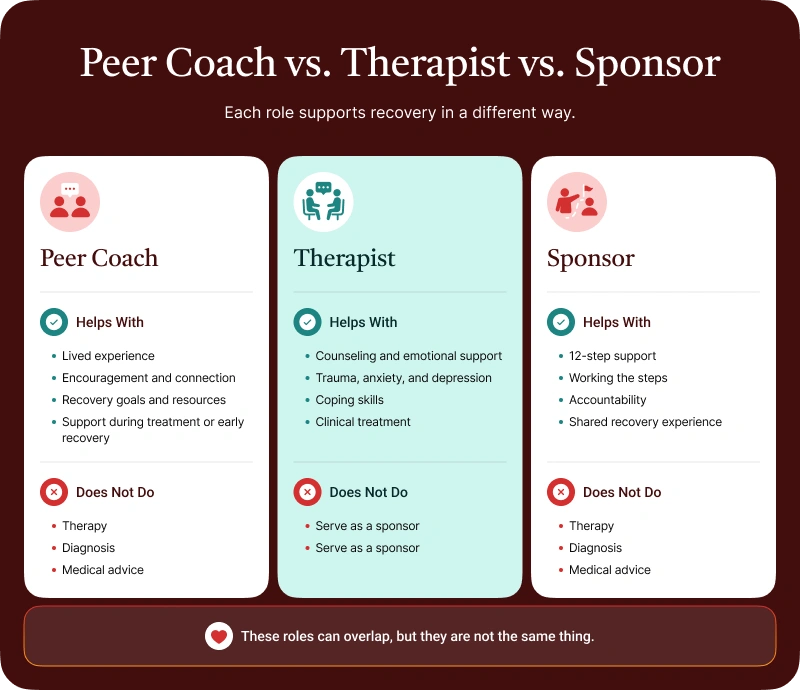
A peer coach is not supposed to have all the answers. They are not there to control someone’s choices or tell them there is only one way to recover.
The best peer coaches know how to say, “I understand this part,” while also knowing when someone needs help from a therapist, doctor, sponsor, case manager, or crisis team.
What a Recovery Peer Coach Is Not
A recovery peer coach is not a therapist, doctor, sponsor, or case manager.
That does not make the role less important. It just means the support is different.
A therapist can help someone work through trauma, mental health symptoms, family patterns, grief, or other clinical concerns. A doctor or medical provider can help with medication, withdrawal symptoms, physical health, or mental health treatment. A sponsor may guide someone through a specific recovery program.
A peer coach supports recovery through lived experience.
That means they can say, “I remember what that felt like,” or “Here is what helped me stay connected when I wanted to isolate myself.” They can encourage someone to use the support around them, talk through next steps, and help them feel less alone.
A peer coach should not diagnose someone, give medical advice, act as someone’s only support, or promise that one specific path will work for everyone.
The role is about connection, encouragement, and practical support. It is not about dictating someone’s recovery or medical care.
Why Alumni Programs Can Be a Good First Step
A lot of people first feel pulled toward peer support in small ways. Maybe someone asks about your experience, or you realize your story could help someone feel less alone.
For Indiana Center for Recovery alumni, staying connected through the alumni community can be a good first step before looking into formal peer coaching. It gives you a way to encourage others, share your experience safely, and stay connected without jumping straight into a certified role.
Peer recovery coaching is a more formal version of that same desire to help. It adds training, boundaries, ethics, and in many cases, certification.
Why Peer Support Can Matter After Treatment
Treatment can give someone structure, support, and clinical care. After treatment, people still need connection. They may be rebuilding routines, repairing relationships, finding support meetings, returning to work, or learning how to ask for help before things get worse.
That is one reason peer support can be so valuable. A peer coach can help bridge the space between treatment and everyday life by offering encouragement, practical support, and lived experience.
At Indiana Center for Recovery, alumni support is part of helping people stay connected after treatment. For some alumni, that connection may lead to volunteering, sharing encouragement, joining alumni events, or eventually exploring peer recovery coaching.
Is Recovery Peer Coaching Right for You?
Wanting to help someone else after treatment is a rewarding experience, and it can help change lives. But before stepping into a support role, it is worth being honest about where you are in your own recovery.
Peer coaching can bring up real emotions. You may hear stories that remind you of your own past. You may want to rescue someone who is not ready. You may feel responsible for choices that are not yours to control.
Before looking into peer coaching, ask yourself:
- Am I steady enough in my own recovery to support someone else?
- Can I listen without trying to fix everything?
- Can I respect a recovery path that looks different from mine?
- Can I keep healthy boundaries?
- Can I share my story in a way that helps the other person?
- Do I have my own support system in place?
You do not need to be perfect. But you do need to be stable enough in your own recovery to support someone else without losing sight of yourself.
Recovery Peer Coaching Certification in Indiana
If you want to become a recovery peer coach in Indiana, certification is usually the next thing to look into.
Certification helps show that you have completed training, understand the role, and know how to support people in a safe and ethical way. It also helps employers, treatment centers, recovery organizations, and community programs know that you have met certain requirements.
Certification matters because peer support is personal, but it still needs structure. Training helps you learn what to say, what not to say, when to ask for help, and how to keep healthy boundaries.
Which Certification Should You Start With?
The right option depends on where you are in your recovery, your experience, and what you want to do next.
If you are just starting to learn about peer support, the CPSP or CPRC-A may be the easiest places to begin researching. These options are more approachable for people who are newer to formal peer support work.
The CPRC is usually a better fit for someone who already has peer recovery support experience, supervision hours, and the required training. It may be a longer-term goal if you want to work in the recovery field professionally.
Here is a simple way to think about it before getting into the details:
| Credential | Best For | Organization | Experience Level |
|---|---|---|---|
| CPSP | State-recognized peer support certification | Indiana DMHA | Beginner-friendly |
| CPRC-A | Introductory peer recovery coach credential | ICAADA | Beginner/intermediate |
| CPRC | Advanced peer recovery coach credential | ICAADA | More experience required |
Best For
State-recognized peer support certification
Organization
Indiana DMHA
Experience Level
Beginner-friendly
Best For
Introductory peer recovery coach credential
Organization
ICAADA
Experience Level
Beginner/intermediate
Best For
Advanced peer recovery coach credential
Organization
ICAADA
Experience Level
More experience required
Before You Apply
Certification requirements, fees, training locations, and application steps can change. Before applying, always check the official Indiana DMHA or ICAADA pages directly. This guide is meant to help you understand your options, but the official credentialing organizations should be your final source for current requirements.
Indiana Certified Peer Support Professional, or CPSP
One option in Indiana is becoming a Certified Peer Support Professional, also called a CPSP.
In Indiana, a CPSP is someone who uses lived experience, personal connection, and formal training to support other people through recovery. Indiana’s Division of Mental Health and Addiction says peers often help people connect with treatment, recovery support, community services, and resource navigation.
To apply for CPSP training and certification in Indiana, you generally need to:
- Be at least 18 years old
- Have lived experience with recovery from a mental health condition, substance use, or problem gambling, or have lived experience helping a family member
- Have a high school diploma or equivalent
- Live or work in Indiana at least 51% of the time
The CPSP training includes 48 hours of training and a proctored exam. Trainings are held at different Ivy Tech locations throughout Indiana. At the time of writing, Indiana says DMHA is covering the fees for CPSP training and the initial exam, so eligible applicants may be able to complete both at no cost.
Current CPSP cost details:
- Training: Indiana currently says the CPSP curriculum includes 48 hours of training.
- Exam: The training includes a proctored exam.
- Location: Training and testing take place at specific Ivy Tech locations throughout Indiana.
- Fees: Indiana’s CPSP page does not list a membership fee like ICAADA does. Because fees and funding can change, check the DMHA CPSP page before applying.
To apply, you need to use the online Certemy portal. Indiana says applicants should be ready to upload a driver’s license or state ID and proof of education, such as a high school diploma, GED, or highest level of education.
A CPSP may be a good option to look into if you want a state-recognized peer support certification and are interested in working or volunteering in Indiana recovery support settings.
Certified Peer Recovery Coach-Associate, or CPRC-A
Another option is the Certified Peer Recovery Coach-Associate, also called CPRC-A.
This is an introductory peer recovery support certification through ICAADA. It is meant for people who have personal lived experience with recovery from substance use, mental health, or co-occurring disorders and want to support others who are seeking or maintaining recovery.
To apply for the CPRC-A in Indiana, you generally need to:
- Be at least 18 years old
- Have a high school diploma, GED, or equivalent
- Have personal lived experience in recovery
- Have at least one year of recovery time
- Live or work in Indiana at least 51% of the time
The CPRC-A also requires recovery support training and ethics training. ICAADA currently lists 35 hours of recovery support fundamentals training and 16 hours of recovery support ethics training as part of the education requirements.
Current ICAADA fees may include:
- Membership fee: $125
- Exam fee: $150 for members or $300 for non-members
- Certification fee: $100 for members or $200 for non-members
The CPRC-A is valid for two years and is not renewable through ICAADA, so it is usually treated as a step toward the full CPRC credential. Fees can change, so check ICAADA’s current fee list before starting the application.
One important detail: ICAADA says not to start the CPRC-A application until all prerequisites and required trainings are complete. If someone starts too early, the application may be deleted. Once the application is started, applicants have six months to complete it.
Certified Peer Recovery Coach, or CPRC
The Certified Peer Recovery Coach, or CPRC, is another peer recovery credential offered through ICAADA.
This certification is usually a better fit for someone who already has some training, supervision, or experience in peer recovery support. It is more involved than the CPRC-A and includes work experience, supervision hours, education requirements, and an exam.
To apply for the CPRC in Indiana, you generally need to:
- Be at least 18 years old
- Have a high school diploma, GED, or equivalent
- Have personal lived experience in recovery
- Have at least one year of recovery time
- Live or work in Indiana at least 51% of the time
- Complete required recovery support and ethics training
- Complete supervised peer recovery support experience
- Pass the required exam
ICAADA currently lists several requirements for the CPRC, including 35 hours of recovery support fundamentals, 16 hours of recovery support ethics, 500 hours of professional recovery support experience, 25 hours of supervision, and passing the IC&RC Peer Recovery Exam. ⓘ
Current ICAADA fees may include:
- Membership fee: $125
- Exam fee: $150 for members or $300 for non-members
- Certification fee: $100 for members or $200 for non-members
- Renewal membership fee: $100
- Certification renewal fee: $100 for members or $200 for non-members
Because this credential requires more experience, it may not be the first step for someone who is just starting to learn about peer coaching. But it can be a strong longer-term goal if you want to work in recovery support professionally.
To learn more, visit ICAADA’s Certified Peer Recovery Coach page and review the current requirements before starting an application.
How to Get Started
Once you understand the different certification options, the next step is to slow down and get organized.
Start by reading the current requirements directly from Indiana DMHA or ICAADA. Make sure you understand the training, fees, recovery time, application steps, and renewal requirements before you apply.
It can also help to gather a few things early, such as:
- A driver’s license or state ID
- Proof of education, such as a high school diploma or GED
- Training certificates
- Recovery support or volunteer experience, if you have it
- Supervision records, if the credential requires them
- References, if they are part of the application
- Notes about your own recovery support system
Before applying, think about what kind of role you actually want. Some people want to volunteer. Some want to support alumni. Some want to work in a treatment center, recovery organization, hospital, crisis program, or community setting.
If you are not ready to apply for certification yet, staying connected through the Indiana Center for Recovery Alumni Program can be a good place to start. Alumni involvement can help you stay connected to recovery, encourage others, and learn more about whether peer support feels like the right next step. It also gives you a chance to practice sharing your story with care, keeping boundaries, and supporting others in a way that does not put your own recovery at risk.
Recovery peer coaching can be a powerful way to use your experience to help someone else, but it works best when it is built on training, boundaries, and stability in your own recovery. Whether you start by joining an alumni program, learning about certification, volunteering, or preparing for a future role in recovery support, the goal is the same: helping someone feel less alone while staying grounded in your own recovery.
Indiana Center for Recovery Locations


 100% Confidential
 Call
Call  Available Now
 Verify Your Insurance

 Call (844) 650-0064
